
PHM Society Webinar Series
The PHM Society Webinar Series is a quarterly initiative that brings together PHM experts from academia, industry, and government. Each session features invited seminars from leading researchers and practitioners in the field. All webinars are livestreamed on the PHM Society YouTube Channel and are followed by an interactive Q&A session. For any questions, please feel free to contact us at seminars@phmsociety.org.
| Seminar 1 | PHM Unplugged – Past Lessons, Future Frontiers | Dr. Kai Goebel |
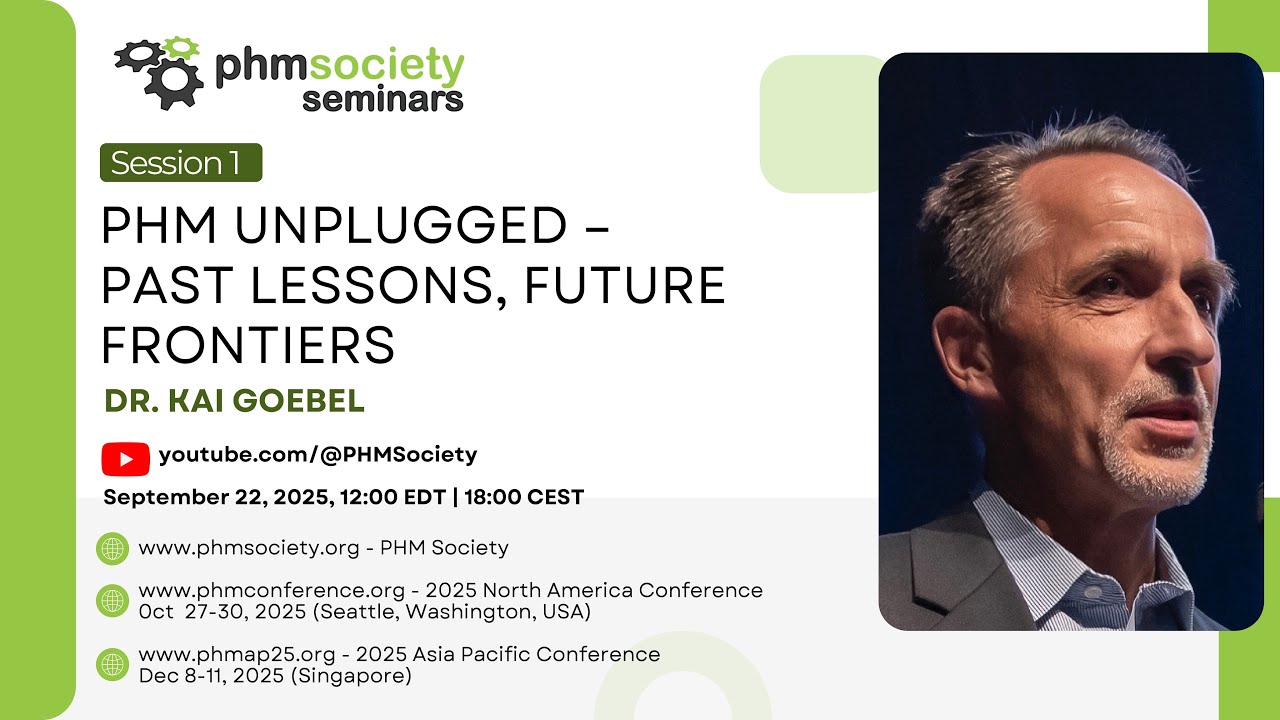 Watch Video (Click on Thumbnail) Abstract (click to expand or collapse)Prognostics and Health Management (PHM) has evolved from a niche research area into a critical enabler of reliability, safety, and cost efficiency across industries. This talk will trace the historical development of PHM, highlighting key milestones in its journey from reactive maintenance to predictive and prescriptive analytics. We will explore how advances in sensing, data analytics, and machine learning have shaped the field, and examine current best practices in deploying PHM systems. Looking forward, the talk will address emerging challenges — including model interpretability, cybersecurity, and integration into resilient system architecture — and propose paths for future research and innovation to ensure PHM continues to deliver value in increasingly autonomous and interconnected environments. About the speaker (click to expand or collapse)Dr. Kai Goebel is considered one of the elders in the field of PHM. He co-founded the PHM Society, where he is still on the board of directors. He has co-authored more than 400 articles on PHM, including seminal work on prognostic performance metrics, uncertainty management, requirements flowdown, and fusing physics with machine learning for prognostics. He founded the Prognostics Center of Excellence at NASA Ames Research Center and made it part of his mission to record run-to-failure data — including the now-infamous CMAPSS dataset — and make them publicly available on the NASA data repository. His research journey brought him to NASA, UC Berkeley, Lulea Technical University, GE Corporate Research and Development, Palo Alto Research Center, and SRI. He |
| Seminar 2 | From Models to Missions: Making PHM Work at Fleet Scale | Dr. Abhinav Saxena |
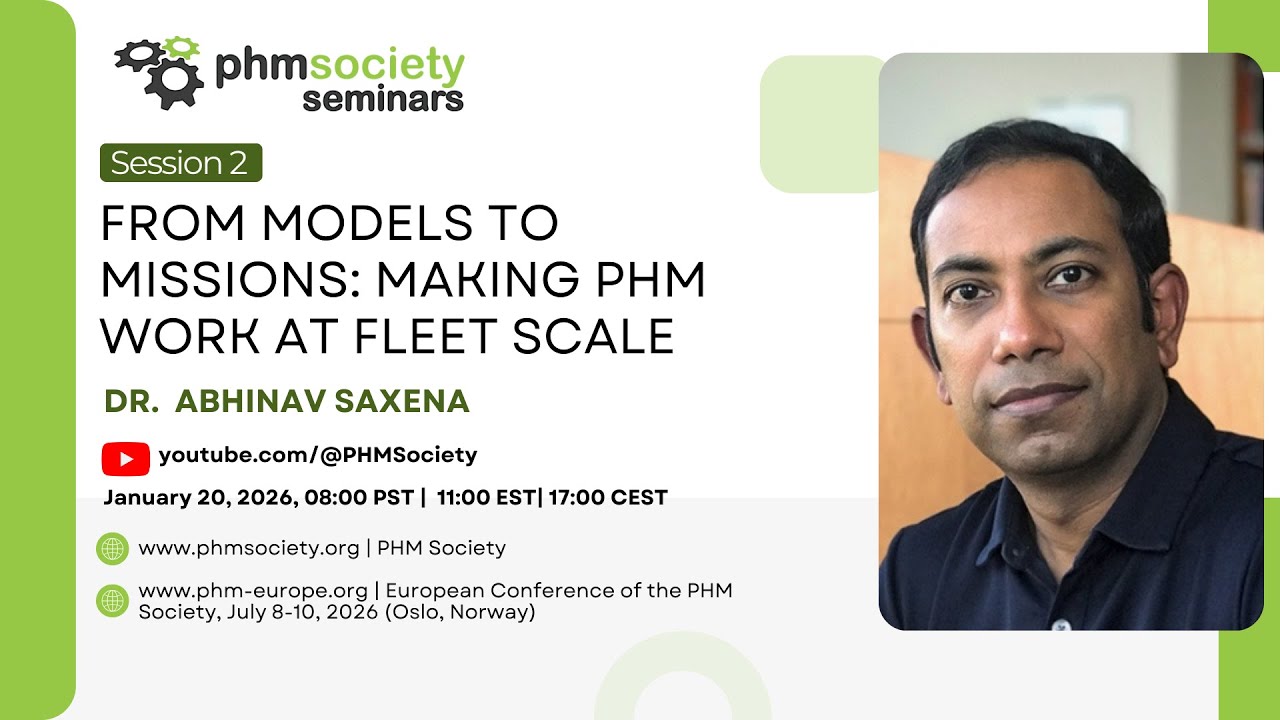 Watch Video (Click on Thumbnail) Abstract (click to expand or collapse)Prognostics and Health Management (PHM) has reached an inflection point. Over the last two decades, the community has delivered powerful foundations for understanding degradation, building diagnostic and prognostic models, estimating remaining useful life, and evaluating PHM performance. Yet in many real deployments, the barriers to impact are no longer primarily algorithmic. They are operational: inconsistent and incomplete data, shifting operating regimes across geographies and operators, edge-versus-cloud constraints, cybersecurity and governance requirements, regulatory differences, and the practical reality of maintaining models over years without an unsustainable version-control burden.Drawing on 15–20 years of experience spanning foundational PHM research at NASA and industrial-scale deployment challenges at GE Research, this talk argues that the next leap in PHM value will come from treating deployment as a first-class technical problem. We will explore why “model once, deploy everywhere” fails for globally operated assets such as jet engines, power generation systems, transportation systems, or medical imaging equipment — and what it will take to build PHM systems that generalize, remain trusted, and continuously prove value in real operations. The talk closes with a forward-looking agenda that bridges near-term deployment priorities with areas where new foundational research is still urgently needed. About the speaker (click to expand or collapse)With over two decades of PHM experience, Abhinav Saxena is a Principal Scientist in AI at GE Aerospace Research. He is passionate about transitioning AI-driven PHM from promising models into deployable, fleet-scale solutions across aviation, power (including nuclear), and healthcare. He served as PI for the ARPA-E GEMINA program on AI-enabled predictive maintenance digital twins for advanced nuclear reactors and has led multi-organization, government-funded PHM programs across agencies. Previously, Abhinav spent more than seven years at NASA Ames Research Center, focusing on foundational research in degradation, diagnostics, and prognostics. He has authored 120+ peer-reviewed publications and co-authored a seminal book on prognostics. A founding member and Fellow of the PHM Society, he has contributed extensively through standards work (SAE, IEEE), education, and leadership, including serving as Editor-in-Chief of the International Journal of Prognostics and Health Management (2011–2020). |
| Seminar 3 | Scaling Industrial PHM with Foundation Models and AI Agents | Prof. Olga Fink |
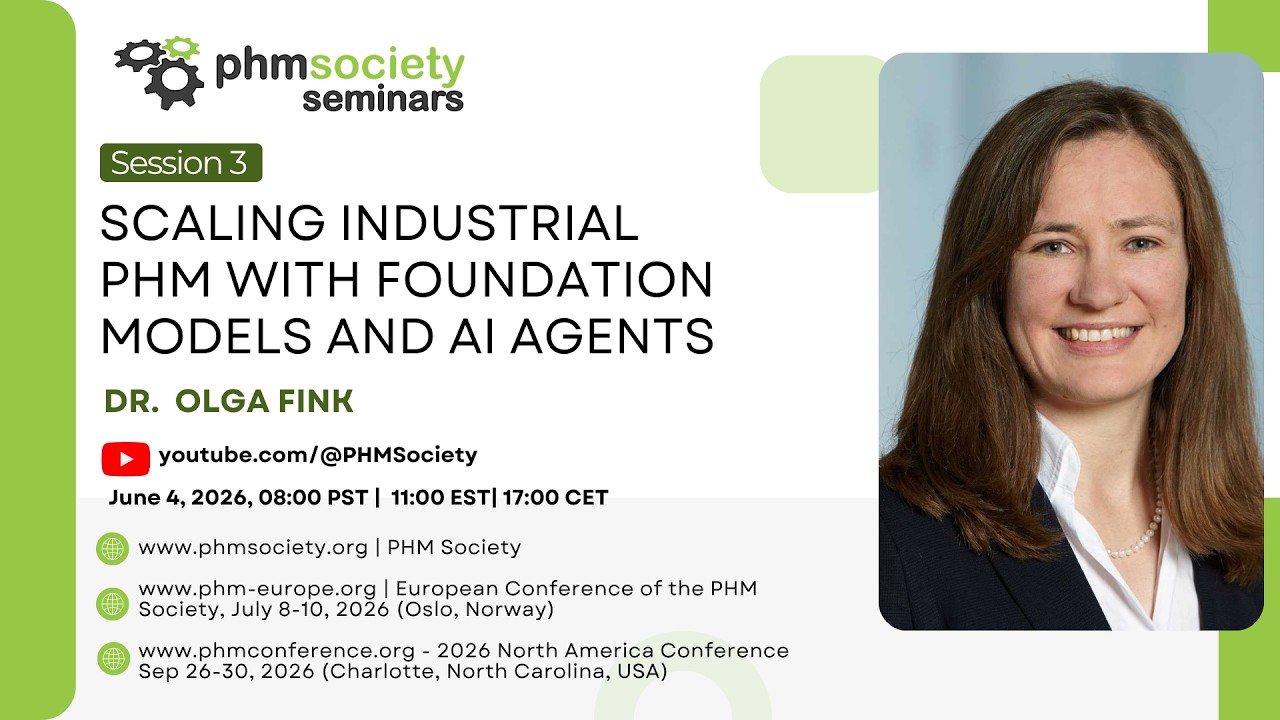 Watch Video (Click on Thumbnail) Abstract (click to expand or collapse)Despite major advances in machine learning, deploying AI algorithms in industrial PHM remains challenging due to limited run-to-failure trajectories, heterogeneous sensor configurations, evolving operating conditions, missing data, and restricted access to industrial datasets. This talk discusses recent directions at the intersection of foundation models, in-context learning, and agentic AI for industrial PHM.First, we discuss why current time-series foundation models are often mismatched with industrial prognostics settings, and argue that tabular foundation models combined with in-context learning provide a promising alternative — adapting across assets and operating conditions without repeated retraining. Second, we discuss agentic approaches for industrial root cause analysis, presenting a hybrid framework that combines statistical models of process-variable dependencies with an LLM-based diagnostic agent for scalable and explainable industrial diagnosis. Finally, we discuss reproducibility in PHM and introduce an agentic, framework-based reproduction workflow that enables executable and systematically comparable benchmark implementations. About the speaker (click to expand or collapse)Prof. Olga Fink has been assistant professor at EPFL since March 2022, heading the Intelligent Maintenance and Operations Systems (IMOS) laboratory, and is the recipient of an ERC Consolidator Grant. Her research focuses on Physics-Informed Machine Learning, Multi-Modal Learning, Domain Adaptation and Generalization, and Reinforcement Learning for Intelligent Maintenance and Operations of Infrastructure and Complex Assets. Before joining EPFL, Olga was assistant professor of intelligent maintenance systems at ETH Zurich (2018–2022), awarded the prestigious SNSF professorship grant. She received her Ph.D. from ETH Zurich and has gained industrial experience as reliability engineer with Stadler Bussnang AG and as reliability and maintenance expert with Pöyry Switzerland Ltd. She is a Fellow of the PHM Society and was recognized as a Young Scientist of the World Economic Forum (2019) and the World Laureate Forum (2020, 2021, 2024). |